
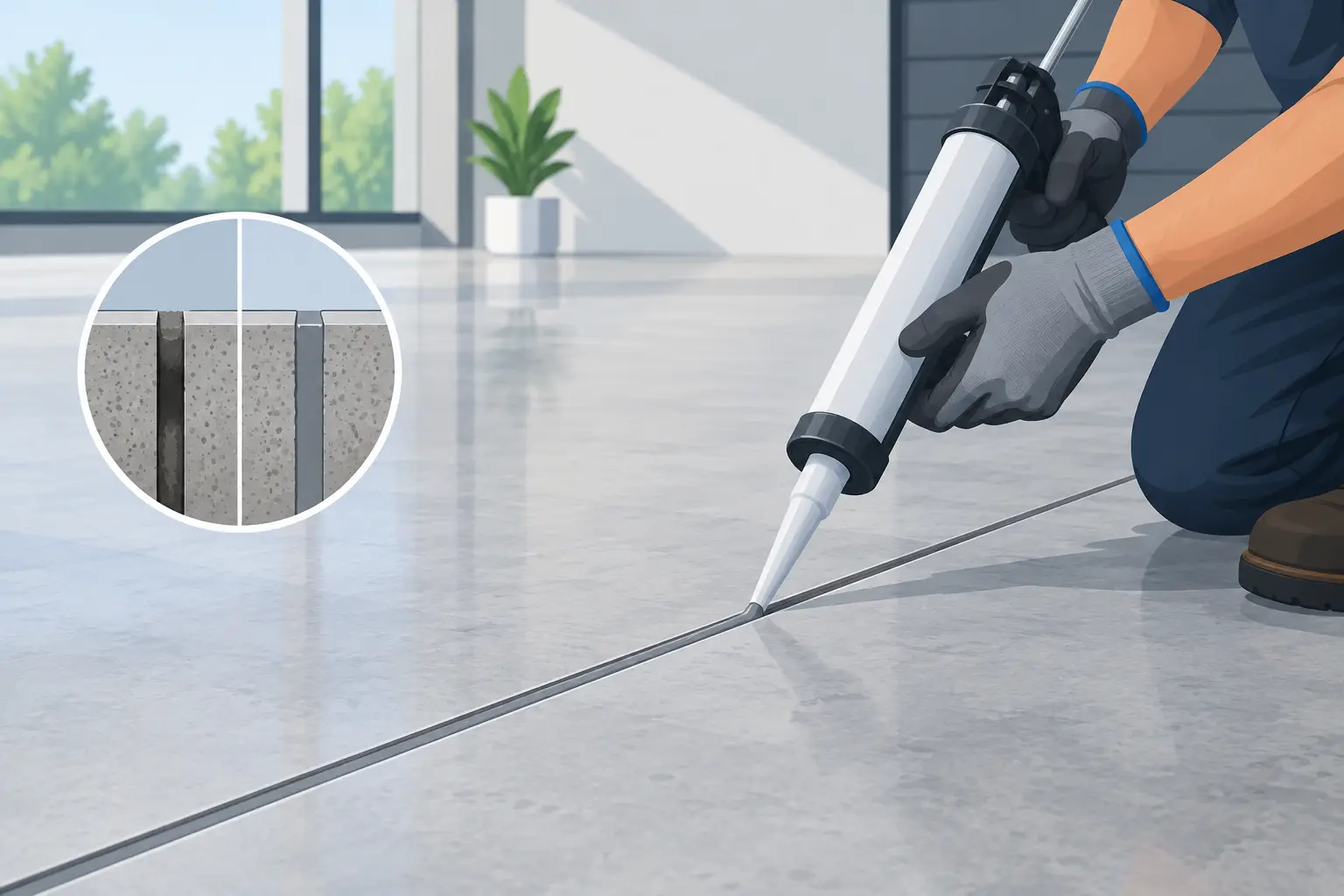
When to Fill Concrete Joints for Lasting Floors
A concrete slab can look solid while its joints become the first place a floor fails. Dirt packs into open cuts, cart wheels chip the edges, moisture finds a path below coatings, and a polished surface starts collecting dark lines that are difficult to clean. Knowing when to fill concrete joints helps protect the floor system before those small problems become expensive repairs.
For garages, retail spaces, warehouses, offices, and industrial facilities, the right timing depends on the joint type, the slab’s age, how much movement is expected, and the finish being installed. Filling every joint with the same material is not the answer. The goal is to use the right filler at the right stage of the project.
When to Fill Concrete Joints Before Finishing
Most saw-cut control joints should be filled after the concrete has completed the majority of its initial shrinkage, not immediately after the slab is poured. Concrete releases moisture as it cures, and that drying process causes minor movement. Filling too early with a rigid material can lead to adhesive failure, cracking at the joint, or a filler that pulls away from the edges.
For many interior slabs, joint filling is often considered after roughly 60 to 90 days of curing and drying. That is a general window, not a rule for every project. Slab thickness, mix design, temperature, humidity, curing methods, and building conditions all affect how quickly the concrete stabilizes. A newer slab in a climate-controlled office may behave very differently from a warehouse slab exposed to open loading doors and changing temperatures.
The intended finish also matters. If the floor will receive a polished concrete finish, densification, grinding, staining, or an epoxy system, the joints should be evaluated before final surface work begins. Open or damaged joints can interfere with grinding equipment, create uneven coating lines, and leave places where contaminants collect.
For an existing floor, there is no need to wait for a calendar date if the slab is already mature. The decision comes down to condition and use. If joints are open, deteriorating, holding debris, or taking repeated wheel traffic, they are likely ready for repair and filling.
Identify the Joint Before Choosing a Filler
Not all concrete joints serve the same purpose. This is the most common source of costly mistakes during flooring work.
Control joints
Control joints, also called contraction joints, are intentionally cut into a slab to encourage shrinkage cracks to form in a controlled location. In a warehouse or garage, these joints are often saw cuts arranged in a grid pattern. Once the slab has stabilized, they are commonly filled with a semi-rigid joint filler to support the joint edges and create a smoother, more serviceable floor.
Semi-rigid epoxy or polyurea fillers are frequently used in interior traffic areas. They help prevent spalling when forklifts, pallet jacks, carts, and vehicle tires cross the joint. They also reduce dirt accumulation and improve the appearance of a polished or coated floor.
Expansion and isolation joints
Expansion joints and isolation joints are different. These joints separate the slab from walls, columns, footings, equipment pads, or adjacent slabs so each section can move independently. They require flexibility. Filling them with a rigid epoxy or hard polyurea can restrict movement and cause the filler, coating, or concrete edge to crack.
These joints are generally sealed with a flexible sealant system selected for the expected movement, exposure, and floor use. The joint may also need a properly sized backer rod to control sealant depth. In areas exposed to water, chemicals, or washdowns, the sealant choice becomes even more critical.
Construction joints
Construction joints occur where one concrete placement stops and another begins. Some act more like control joints, while others need to accommodate movement. Their condition and design should be reviewed before choosing a filler. A contractor should not assume that every straight line in a concrete slab is a standard saw-cut joint.
Signs It Is Time to Fill or Repair Joints
A joint does not have to be completely broken down before it needs attention. Early repairs are usually cleaner, less disruptive, and more affordable than waiting until concrete edges have failed.
Look for joint edges that are chipping or flaking, especially where wheeled traffic crosses the slab. This type of damage, known as spalling, often starts when hard wheels impact unsupported joint edges. Warehouses, airplane hangars, service bays, and retail stockrooms are especially vulnerable.
Dark buildup along the joints is another practical signal. If cleaning does not remove the embedded debris, an open joint may be trapping oils, dust, and moisture. In food service, healthcare-adjacent spaces, showrooms, and residential garages, that can make a floor look neglected even when the rest of the surface is clean.
Other signs include loose old filler, gaps between the filler and concrete, cracks branching away from the joint, coating separation, or water entering the joint. If an epoxy floor is peeling near joints, the issue may be movement, moisture, poor joint preparation, or the wrong filler type. Coating over the symptom without correcting the joint usually leads to repeat repairs.
Joint Filling for Polished Concrete Floors
Joint filling is usually part of the polishing process, not an afterthought. During early grinding stages, the crew can remove failed filler, clean the joint walls, and evaluate whether the joint needs repair before installing new material. The filler is then trimmed or ground flush as the floor progresses through finer polishing steps.
For a polished concrete floor, color can matter as much as performance. A neutral gray filler may blend into a natural concrete floor, while black or tinted filler can emphasize the joint pattern as a deliberate design feature. In a retail showroom or modern residential interior, that choice should be made early because the joints remain visible in the finished floor.
A filled joint will not disappear completely. Concrete moves, and joint filler has a different texture and color than the slab. A properly completed joint should look clean, flush, and intentional while protecting the edges from damage. Anyone promising invisible joints on an active concrete slab is setting the wrong expectation.
Joint Filling Before Epoxy and Other Coatings
Before epoxy, urethane cement, or resurfacing systems are installed, joints need a project-specific plan. Some control joints can be filled and coated over when the system is designed for that application. Others may need to remain visible or receive a flexible detail because movement is expected.
Moisture testing is also essential. A slab may appear dry but still transmit moisture vapor that affects coating adhesion. Joint areas can be particularly vulnerable because they create pathways for moisture and contaminants. Proper surface preparation, including grinding, cleaning, crack repair, and moisture evaluation, gives the coating its best chance of long-term performance.
For garages, a joint filler may be installed before the epoxy system so the floor is easier to clean and less likely to collect debris. For industrial facilities with heavy traffic, a higher-strength semi-rigid filler may be selected specifically to protect the slab edges. The right solution depends on whether the priority is appearance, impact resistance, chemical resistance, movement accommodation, or all of the above.
Why Timing Changes With the Environment
Indoor conditioned spaces are generally more predictable than exterior concrete. Exterior slabs experience direct sun, rain, temperature swings, and seasonal movement. A hard joint filler that performs well inside a warehouse may not be appropriate on an exposed patio, driveway, or parking area.
Chemical exposure changes the recommendation as well. Automotive fluids, cleaning chemicals, food oils, and industrial materials can attack certain sealants and fillers. Facilities that wash floors regularly need joints that resist moisture intrusion without creating a hard, incompatible bridge across a moving joint.
Traffic is equally important. A residential garage with passenger vehicles does not place the same demands on joints as a distribution center operating forklifts all day. Heavy wheels, narrow load points, and constant crossings increase the need for edge support and timely repairs.
Get the Joint Plan Right Before Work Starts
Joint repair is a small part of the floor by square footage, but it has an outsized effect on the finished result. The best time to address joints is before polishing, coating, or resurfacing makes access more difficult. A site review can determine which joints should receive semi-rigid filler, which need flexible sealant, and which may require concrete edge repair first.
Orange County Concrete Polishing evaluates the slab, traffic conditions, finish requirements, and scheduling needs before recommending a flooring system. For occupied commercial spaces, joint repair and floor finishing can often be planned around off-hours to reduce disruption.
If your concrete joints are collecting debris, showing edge damage, or holding back a planned floor upgrade, address them before the problem spreads across the slab. A properly prepared joint helps the entire floor clean easier, wear better, and look finished for years.
Recent Post

Best Industrial Floor Systems for Demanding Sites
October 16, 2026 1:51 am
How to Prevent Concrete Delamination Early
October 14, 2026 1:51 am

Warehouse Floor Safety Guide for Busy Facilities
October 12, 2026 1:45 am