
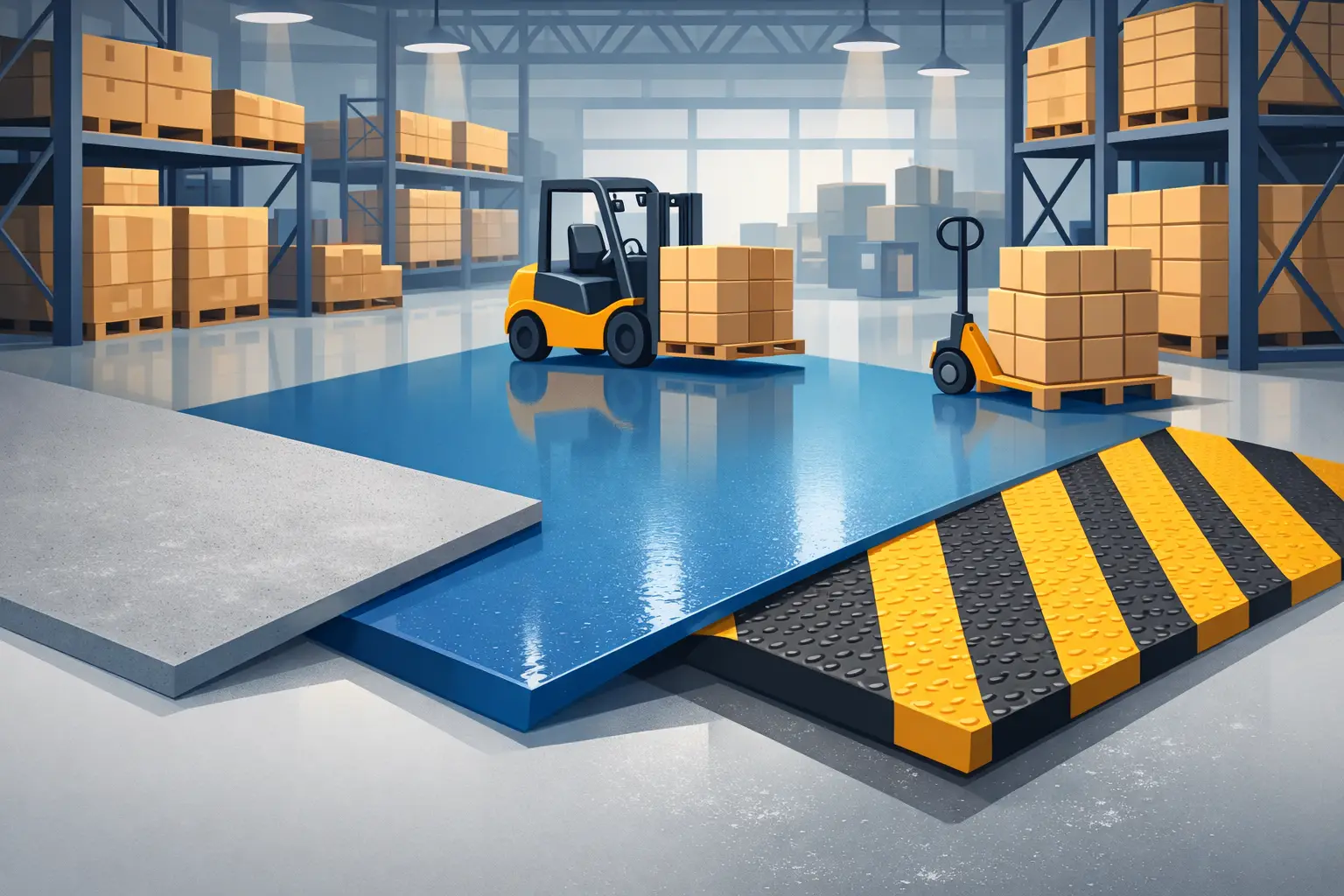
Best Warehouse Floor Finishes for Heavy Use
A warehouse floor takes more punishment than almost any other surface in a facility. Forklifts pivot in tight lanes, pallets scrape during loading, carts rattle across joints, and spills can turn an ordinary concrete slab into a maintenance problem. The best warehouse floor finishes are not chosen by color alone. They are selected around traffic patterns, chemical exposure, cleaning practices, downtime limits, and the condition of the concrete already in place.
For Orange County facility managers, the right finish can reduce dust, simplify cleanup, improve visibility, and help protect the slab from premature wear. The wrong system can peel under tire traffic, become slippery when wet, or require repairs long before it should. A proper site evaluation is the difference.
What the Best Warehouse Floor Finishes Must Handle
A finish that performs well in a light-duty storage room may fail quickly in a distribution center. Before selecting a coating or treatment, look at what the floor handles during a normal shift and what happens during the busiest week of the year.
Forklift traffic is usually the first concern. Hard wheels, repeated turning, and loaded pallet jacks create concentrated stress that can wear down weak coatings and expose poorly prepared concrete. Facilities with battery charging, vehicle maintenance, food handling, or manufacturing also need to consider oil, fuel, cleaners, acids, and other chemical exposure.
Safety matters just as much. A glossy finish may brighten a space, but a warehouse with water, oils, or frequent washdowns may need a broadcast aggregate or another traction-enhancing detail. The goal is not simply a floor that looks finished. It is a floor that supports the way your operation actually works.
Start with the concrete itself
No finish can compensate for an unaddressed slab problem. Before installation, a contractor should inspect for moisture vapor, cracks, spalling, failing patches, surface contaminants, soft concrete, and uneven areas. Old adhesive, curing compounds, tire residue, and oil can prevent a coating from bonding correctly.
Mechanical surface preparation is a major part of long-term performance. Concrete grinding, shot blasting, repair work, and joint treatment create the clean, properly profiled surface a coating needs. Skipping this step to save time usually costs more once delamination or peeling begins.
Epoxy Systems for Chemical Resistance and Color Control
Epoxy remains one of the most practical warehouse floor finishes when a facility needs chemical resistance, a clean appearance, and a defined color system. It can be installed in solid colors, with safety striping, equipment zones, pedestrian walkways, and clearly marked work areas.
A properly specified industrial epoxy system creates a protective layer over the concrete. This helps limit staining from oils and many common industrial fluids while making routine sweeping and mopping easier. It is a strong option for warehouses, maintenance bays, light manufacturing spaces, stock rooms, and loading-adjacent work zones.
Epoxy is not one single product. Thickness, resin quality, topcoat selection, and surface preparation all affect performance. A thin, low-cost coating may look good when installed but struggle under forklift turning and frequent impacts. For a high-traffic warehouse, a professionally installed multi-coat system is usually the better investment.
There are trade-offs. Standard epoxy can be sensitive to ultraviolet light, so areas exposed to direct sun near open doors may benefit from a UV-stable topcoat. Epoxy also requires appropriate cure time before traffic resumes. For facilities with limited shutdown windows, scheduling and product selection need to be planned early.
Urethane and Polyaspartic Topcoats for Tougher Service
Urethane and polyaspartic coatings are often used where abrasion resistance, chemical protection, and faster return to service are priorities. They can be installed as complete systems or as protective topcoats over epoxy, depending on the warehouse environment.
A urethane topcoat is especially useful where equipment traffic and repeated cleaning create surface wear. It can add durability and help maintain the appearance of an epoxy base coat. Polyaspartic systems are known for fast curing, which can be valuable when a business needs work completed during nights, weekends, or a short operational shutdown.
Fast cure does not mean rushed preparation. The slab still needs to be cleaned, profiled, repaired, and tested as required. A coating system only performs as well as its bond to the concrete. For active warehouses, the right contractor will phase the work around usable zones, access routes, and delivery schedules whenever possible.
When traction should be built into the system
Smooth floors are easier to clean, but they are not always the safest choice. Warehouse floors exposed to water, oils, wet tires, or regular washdowns may need a traction additive or broadcast aggregate. This creates more grip without turning the surface into something difficult to maintain.
The amount and type of aggregate should match the operation. Too little may not improve safety enough. Too much can make cleaning harder and increase wear on certain wheels. A tailored sample area can help a facility manager confirm the desired texture before a larger installation begins.
Polished Concrete for Low-Maintenance Warehouses
Polished concrete is a strong choice for dry warehouses that want a durable, clean, low-maintenance floor without a film-forming coating. The process mechanically refines the concrete surface, then densifies and polishes it to the selected level of sheen.
For distribution areas, retail warehouses, showrooms, and facilities with primarily dry traffic, polished concrete offers practical advantages. It reduces concrete dusting, reflects more light than unfinished concrete, and stands up well to daily foot traffic and many types of wheeled equipment. It also avoids the peeling concerns associated with coatings because the finish is developed within the concrete surface rather than sitting on top of it.
Polished concrete is not the best answer for every warehouse. It does not provide the same chemical barrier as a high-build epoxy or urethane system. If the floor sees frequent oil spills, corrosive materials, or aggressive chemical washdowns, a coating may provide better protection. Existing slab condition also matters. Extensive patching, unevenness, and major surface damage can affect the final appearance and may require repairs or resurfacing before polishing.
Concrete Densifiers and Sealers for Budget-Conscious Protection
For facilities that need to control dust and improve cleanability without a full decorative coating system, a concrete densifier or penetrating sealer may be a practical option. Densifiers react with the concrete to strengthen the surface and reduce dusting. Penetrating sealers can help limit absorption of water and certain contaminants.
These treatments are often useful in utility areas, older storage spaces, and warehouses where the floor needs improvement but a full shutdown is not feasible. They preserve a more natural concrete appearance and generally involve less visual customization than epoxy or polished concrete.
The limitation is protection level. A densifier will not hide heavy stains, repair failing concrete, or provide the same chemical resistance and color coding available with a resinous system. It is a functional solution, not a cure-all. The right choice depends on the floor’s current condition and the performance standard the facility needs to meet.
Resurfacing for Damaged or Uneven Warehouse Slabs
When a warehouse slab is badly spalled, cracked, rough, or uneven, applying a finish directly over the surface can be a short-lived fix. Resurfacing, patching, grinding, and leveling may be needed first to create a sound substrate.
This is particularly common near loading docks, forklift turning areas, entry points, and zones where old coatings have failed. Repairs should address the cause of the damage whenever possible. Moisture, impact, poor drainage, and slab movement can all affect how long a repaired area lasts.
A resurfaced floor can then receive an epoxy, urethane, polyaspartic, or other suitable finish. This approach adds cost compared with coating a clean, sound slab, but it protects the investment by giving the new system a stable foundation.
How to Choose the Right System for Your Facility
The right decision usually comes down to a few operational questions. What equipment moves across the floor? Are chemicals, oils, or standing water involved? Does the space need slip resistance? How much downtime is available? Does the floor need safety colors, striping, or a brighter finished appearance?
A busy fulfillment warehouse with dry forklift traffic may benefit from polished concrete or a densified finish. A maintenance warehouse with fluids and frequent spills may need epoxy with a urethane topcoat and traction additive. A facility that cannot close for several days may be a better fit for a fast-curing polyaspartic system, provided the concrete preparation can be completed correctly.
At Orange County Concrete Polishing, warehouse flooring recommendations begin with the slab and the operation, not a one-size-fits-all product. An in-person assessment makes it possible to identify repair needs, moisture concerns, traffic loads, and scheduling constraints before the work is scoped.
A warehouse floor should make daily operations easier, not create another item for your maintenance team to manage. Get the floor evaluated before damage spreads or an outdated coating becomes a safety concern, and choose a finish built for the traffic your facility carries every day.
Recent Post
Best Industrial Floor Systems for Demanding Sites
October 16, 2026 1:51 am
How to Prevent Concrete Delamination Early
October 14, 2026 1:51 am
Warehouse Floor Safety Guide for Busy Facilities
October 12, 2026 1:45 am