
Residential Concrete Floor Finishes That Last
A garage floor that flakes under hot tires or an interior slab covered in dull paint is not a concrete problem. It is usually a finish-selection problem. The right residential concrete floor finishes turn an exposed slab into a clean, durable surface that fits how you actually use the space, whether that means parking vehicles, hosting guests, working in a home gym, or managing an active household.
Concrete is not a one-finish material. Its condition, moisture level, location, traffic, and desired appearance all affect the system that will perform best. A finish that looks great in a dry living room may be a poor choice for a sun-exposed garage or pool-adjacent patio. That is why an in-person evaluation matters before anyone promises a price or a finish.
Choosing Residential Concrete Floor Finishes
Start with the job the floor needs to do. A decorative finish should still be easy to clean. A garage coating should still look professional. And a finish that resists stains must be properly prepared, installed, and protected at the edges, joints, and transitions.
For most homes, the best decision comes down to four questions: Is the slab structurally sound? Will the floor see moisture, direct sunlight, vehicles, or chemicals? Do you want the concrete itself to remain visible? And how much maintenance are you willing to accept over time?
A professional contractor should inspect cracking, previous coatings, concrete hardness, oil contamination, moisture vapor, and floor flatness. Surface preparation is not an optional add-on. Grinding, patching, leveling, and cleaning create the profile a coating needs to bond and the smooth foundation a polished or decorative floor needs to look right.
Polished concrete for clean, modern interiors
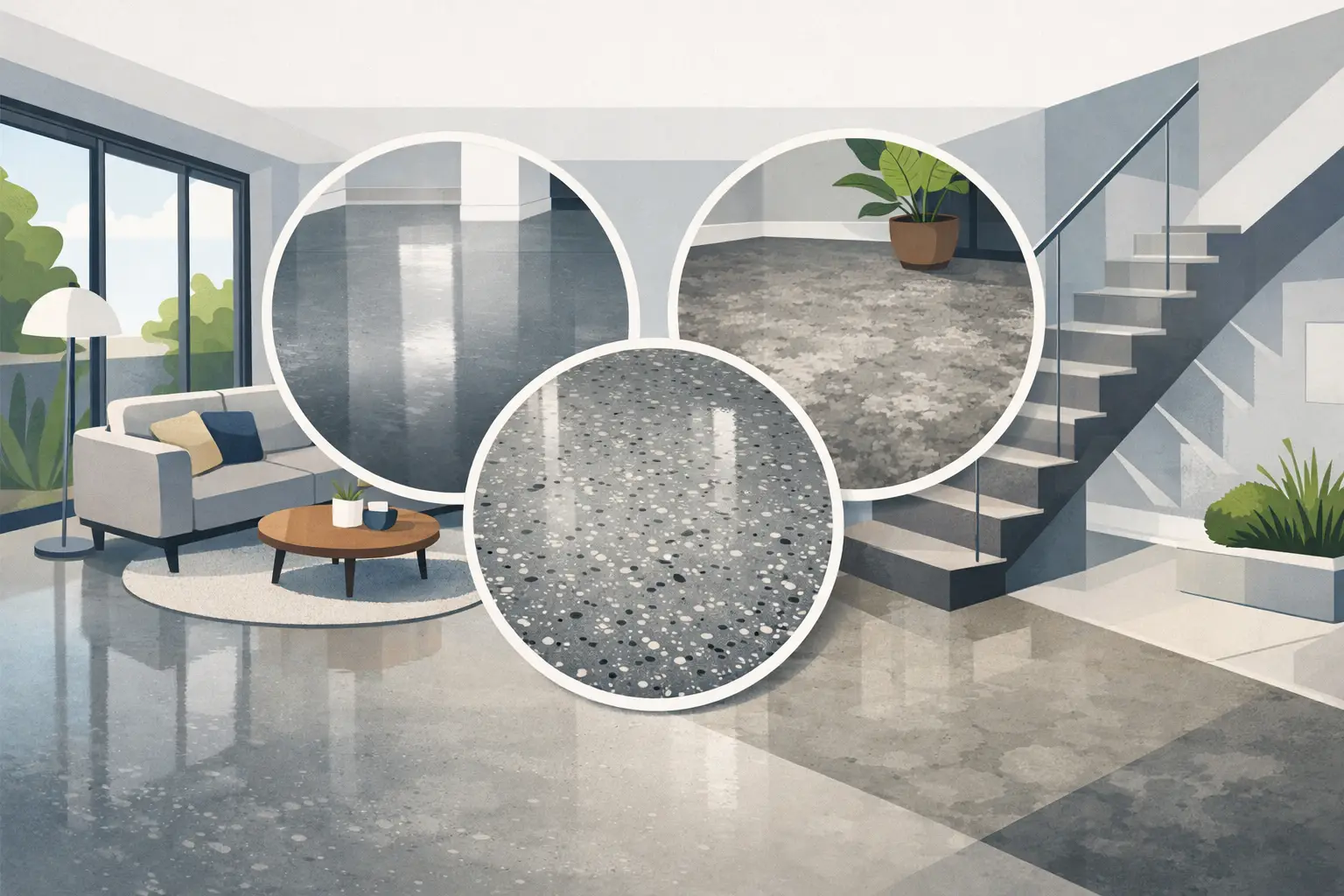
Polished concrete is a strong choice for living areas, kitchens, hallways, basements, and modern garage spaces where homeowners want a refined surface without covering up the character of the slab. The concrete is mechanically ground, honed, densified, and polished to the chosen level of sheen.
The finished floor is dense, low-maintenance, and easy to clean. It does not peel like a surface coating because the finish is created within and at the surface of the concrete. Polished concrete also works well with radiant heat and can make open interiors feel brighter by reflecting available light.
There are trade-offs. Existing slabs often contain color variation, patch marks, aggregate, and small imperfections that become part of the final appearance. That character is attractive to many homeowners, but it is not the same as a uniform tile or vinyl floor. Deep cracks and major level issues may require repairs that remain visible, especially on a high-gloss finish.
Epoxy and polyaspartic systems for garages
For garages, workshops, and utility rooms, epoxy flooring systems remain popular because they create a protective barrier over the concrete. A properly installed system can improve chemical resistance, simplify cleanup, and give an older slab a completely new appearance.
Decorative flake systems are especially practical in residential garages. The flakes help disguise dust, minor debris, and small imperfections while adding texture and visual depth. The topcoat can be selected for gloss level, stain resistance, and traction. This is a far better approach than applying a thin DIY coating over unprepared concrete.
Epoxy does have installation requirements. Moisture vapor beneath the slab can affect adhesion, and direct UV exposure can discolor some epoxy products over time. In sunlit garages or areas with exterior exposure, a UV-stable polyaspartic or urethane topcoat may be the better fit. The right system depends on the slab and the environment, not on a one-size-fits-all package.
Stains and dyes for decorative concrete character
Concrete stains and dyes add color while allowing the surface variation of the slab to show through. They can work well in interior spaces, covered patios, and decorative areas where homeowners want warmer color than natural gray concrete provides.
Acid stains create variegated, mineral-like movement. Dyes offer more predictable color options and can be used with polished concrete for a sharper, more contemporary look. Both can produce attractive results, but neither will hide poor repairs, heavy staining, or uneven concrete. In fact, they can make those conditions more noticeable.
A protective sealer or guard is typically part of the system. The level of protection should match the space. A decorative family-room floor has different needs than a garage that sees oil drips, road grime, and tire traffic every week.
Overlays and resurfacing for damaged slabs
When the existing concrete is badly worn, spalled, stained, or uneven, resurfacing may be the better investment. A concrete overlay can create a new finishable surface over a properly prepared slab, giving homeowners more control over color, texture, and appearance.
Resurfacing is useful for patios, entryways, garages, and interior areas where the original slab cannot deliver the desired look on its own. It can also address localized surface damage before a coating or decorative treatment is installed. However, an overlay is not a cure for active structural movement or unresolved moisture problems. Those conditions need to be identified first.
Match the Finish to the Room
A garage demands abrasion resistance, chemical resistance, and easy cleanup. A polished floor, flake epoxy system, or polyaspartic coating can all work, but the best option depends on vehicle use, sunlight, moisture, and the appearance you want.
Interior spaces often favor polished concrete, stained concrete, or a decorative overlay. These finishes create a continuous floor with no grout lines and fewer places for dust to collect. They are especially effective in contemporary homes, converted garages, ADUs, and ground-floor living areas built on slab foundations.
For patios and exterior concrete, traction and UV performance become more important. High-gloss finishes can be slippery when wet, so a textured or slip-resistant system may be the smarter choice. The same goes for laundry rooms, mudrooms, and pool-adjacent spaces where water is part of normal daily use.
What Determines Long-Term Performance
The finish material matters, but installation quality matters just as much. Floors fail when coatings are applied over weak concrete, contaminated surfaces, or inadequate surface profiles. They also fail when moisture issues are ignored or when a product is chosen for color alone.
A dependable installation starts with preparation. Depending on the project, that may include diamond grinding, crack repair, joint treatment, moisture mitigation, leveling, and removal of old paint or adhesive. These steps are what allow a finished floor to bond correctly and wear evenly.
Maintenance is straightforward once the right system is installed. Sweep or dust mop regularly, clean spills quickly, and use cleaners recommended for the specific finish. Avoid harsh acids and abrasive tools that can dull protective topcoats or damage polished surfaces. Garage floors also benefit from occasional deeper cleaning to remove tire residue and automotive fluids.
Get a Finish Built for Your Concrete
The cheapest coating is rarely the lowest-cost floor over time. If it peels, discolors, or requires replacement after a few seasons, the savings disappear quickly. A well-scoped system may cost more upfront, but it should match the condition of your slab and the way your household uses the space.
Orange County Concrete Polishing evaluates each floor in person so the recommendation is based on actual site conditions, not a generic product pitch. From polished interior concrete to decorative garage coatings and resurfacing solutions, the goal is a finish that looks right on day one and holds up under real use.
Before choosing a color chip or sheen level, schedule an on-site assessment. Seeing the slab, the lighting, the traffic pattern, and the existing damage is the fastest way to choose a residential floor finish you will still be happy to walk on years from now.
Recent Post
Overnight Floor Installation Planning That Works September 20, 2026 1:51 am
Top Commercial Floor Coating Options for Business September 18, 2026 1:53 am
What Causes Epoxy Floor Bubbles? 7 Common Reasons September 16, 2026 1:53 am