
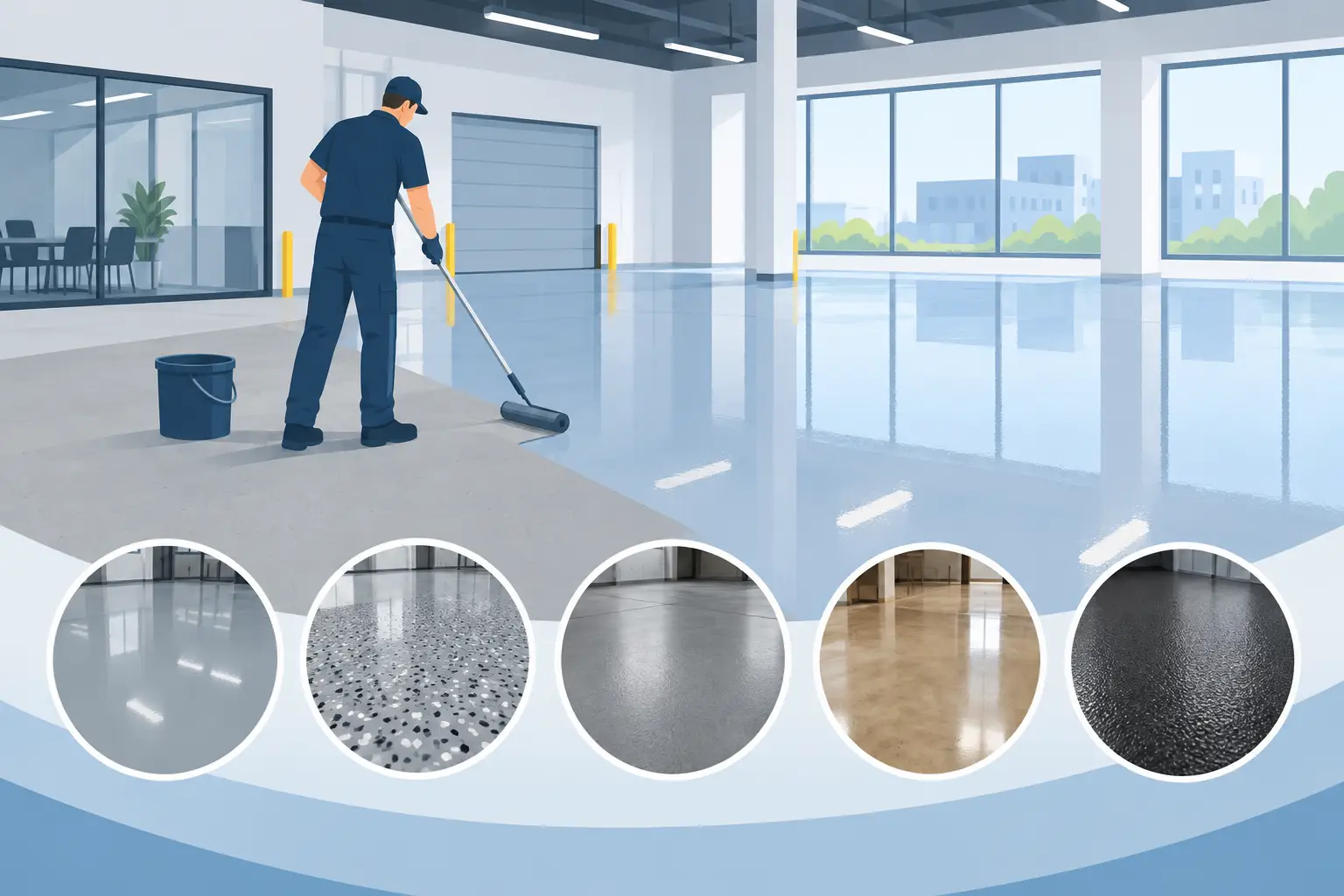
Top Commercial Floor Coating Options for Business
A commercial floor has to do more than look clean on opening day. It has to handle forklift traffic, rolling carts, dropped tools, chemical spills, daily mopping, and the constant abrasion that comes with doing business. The top commercial floor coating options are not interchangeable. The right system depends on how the space operates, what the concrete is doing now, and how much downtime your facility can afford.
For Orange County property owners and facility managers, the best result starts with matching the coating to the environment – not choosing a finish based on color alone. A warehouse, commercial kitchen, auto service bay, retail showroom, and airplane hangar all place very different demands on a floor.
What a Commercial Coating System Must Handle
Before selecting a material, look at the conditions beneath and above the slab. Concrete moisture, surface contamination, cracks, old coatings, and uneven areas all affect adhesion. A high-performance coating applied over poorly prepared concrete can peel, blister, or fail early.
Traffic is equally important. Foot traffic is one thing; pallet jacks, forklifts, carts, and vehicle tires are another. Consider whether the floor sees oils, solvents, food acids, cleaning chemicals, hot equipment, standing water, or direct sunlight. The coating should also support safe operations, which may mean adding a traction profile in wet or spill-prone areas.
Downtime matters as well. Some systems need several days to cure, while others can return to service much faster. A contractor should build the project schedule around your operating hours whenever possible, including nights or weekends for occupied commercial spaces.
Top Commercial Floor Coating Options Compared
Epoxy Floor Coatings
Epoxy remains one of the most requested commercial floor coating systems because it delivers a thick, durable, highly customizable finish. When installed over properly prepared concrete, epoxy creates a dense surface that resists many oils, chemicals, stains, and impacts. It is a strong choice for warehouses, retail backrooms, medical facilities, showrooms, garages, manufacturing areas, and general commercial spaces.
Epoxy is available in solid colors, decorative flakes, quartz broadcast systems, and metallic finishes. That flexibility makes it useful when a facility needs both performance and a professional appearance. Safety striping, designated work zones, and color-coded traffic lanes can also be incorporated into the system.
The trade-off is that epoxy is sensitive to surface preparation, moisture conditions, and temperature during installation. It can also yellow with prolonged UV exposure if used in sunlit areas without a UV-stable topcoat. For indoor commercial floors, though, a well-specified epoxy system often provides excellent value over its service life.
Polyaspartic Coatings
Polyaspartic coatings are known for fast cure times and strong UV stability. They are often used where a business needs a durable floor but cannot shut down for several days. Depending on site conditions and system design, polyaspartic floors may be installed and returned to service significantly faster than traditional epoxy systems.
This option works well for retail spaces, automotive service areas, commercial garages, lobbies, showrooms, and facilities with sunlight exposure. Polyaspartic topcoats hold color better than standard epoxy in UV-exposed areas, and they can be paired with decorative flake systems for a clean, finished look.
Fast installation does not mean rushed installation. Concrete still needs proper grinding, crack repair, cleaning, and moisture evaluation. Polyaspartic materials cure quickly, so experienced crews must work efficiently and control conditions carefully. For projects with limited access windows, that speed can be a major advantage.
Urethane Cement Systems
Urethane cement is built for demanding environments where heat, moisture, thermal shock, and aggressive cleaning are routine. Commercial kitchens, food processing facilities, breweries, cold storage areas, loading zones, and manufacturing plants commonly benefit from this type of system.
Unlike many standard coatings, urethane cement performs well where hot washdowns, steam, frequent sanitizing, and temperature swings can stress the slab. It is also a practical choice for floors exposed to organic acids, food byproducts, and harsh cleaning agents. Textured finishes can be added to improve slip resistance where water or grease is present.
The appearance is generally more functional than decorative, although color and finish options are available. Urethane cement also tends to be a higher-investment system than a basic epoxy coating. In the right environment, its performance under severe conditions can make that investment worthwhile.
MMA Floor Coatings
Methyl methacrylate, commonly called MMA, is a rapid-curing resin flooring system designed for facilities that need minimal downtime. It can cure in cold conditions and may return to service quickly, making it useful for restaurants, grocery areas, healthcare environments, food facilities, and projects with short overnight shutdown windows.
MMA systems offer good chemical resistance and can be installed with a textured surface for wet-service areas. They are especially useful when a long closure would create an operational or revenue problem.
The main consideration is installation odor. MMA has a strong smell while it is being applied, so ventilation and project planning are essential. It is not the automatic answer for every commercial project, but it can be the right answer when time is the controlling factor.
Polished Concrete With Protective Guard
Polished concrete is not a coating, but it deserves consideration when a commercial owner wants a low-maintenance concrete floor without a film-forming layer. The process mechanically refines the slab to create a denser, smoother, more light-reflective surface. A penetrating guard can help reduce staining and simplify routine cleaning.
This finish is popular in retail stores, offices, showrooms, schools, warehouses, and modern commercial interiors. It does not peel like a coating because there is no thick coating layer sitting on top of the concrete. It also offers a clean industrial look that works with a wide range of design styles.
Polished concrete is not ideal for every setting. It does not provide the same chemical barrier as a high-build epoxy or urethane cement system, and heavily damaged slabs may need substantial repair before polishing. When aesthetics, light reflectivity, and low routine maintenance are the priority, it can be a strong long-term solution.
Choosing the Right System for Your Facility
The best coating choice usually becomes clear once the operating conditions are defined. A retail showroom may benefit from decorative epoxy or polyaspartic because appearance, cleanability, and fast installation matter. A warehouse may need a high-build epoxy system designed around forklift routes and impact zones. A restaurant kitchen or food-processing room may need urethane cement with a slip-resistant profile and proper cove base detailing.
Parking structures and exterior-adjacent areas require special attention to moisture, UV exposure, tire traffic, and water management. Auto shops and industrial facilities need systems that stand up to oils, chemicals, and heavy equipment. Offices may prioritize a polished or decorative concrete finish that looks professional without creating high maintenance demands.
There is no one-size-fits-all floor coating. A less expensive system can become costly if it is not built for the actual service conditions. On the other hand, specifying an industrial-grade system for a light-duty office space may add cost without adding meaningful value.
Surface Preparation Determines Performance
The coating is only as reliable as the concrete beneath it. Proper surface preparation commonly includes diamond grinding, shot blasting, removal of old adhesives or coatings, crack repair, joint treatment, and concrete leveling where needed. The goal is to create a clean, properly profiled surface that allows the system to bond as intended.
Moisture testing should be part of the evaluation, especially for ground-level slabs and older buildings. Excess moisture vapor can push against a coating from below and cause adhesion failures. When moisture is present, the solution may involve a vapor-mitigation primer or a different flooring approach.
This is why an in-person assessment matters. Photos can show color and general condition, but they cannot fully reveal slab hardness, contamination, moisture concerns, or the amount of preparation required.
Plan for Cleaning, Safety, and Future Repairs
A commercial floor should be easy to maintain with the cleaning methods your team actually uses. Some textured systems improve traction but can require more attention during cleaning. A smoother finish is easier to mop but may not be appropriate where water, grease, or spills are common. The right balance protects both operational efficiency and employee safety.
Ask about repairability, too. High-traffic areas eventually take wear. A properly designed system can often be repaired or recoated in targeted sections rather than requiring a complete replacement. Planning traffic lanes, expansion joints, and transition areas correctly from the beginning helps keep future maintenance manageable.
A floor coating should support your operation instead of interrupting it. Orange County Concrete Polishing can evaluate your slab, traffic demands, chemical exposure, and schedule to recommend a system that fits the way your business actually runs. A clear on-site quote and the right preparation plan will give you a finish that continues working long after the installation crew leaves.
Recent Post
Overnight Floor Installation Planning That Works September 20, 2026 1:51 am
What Causes Epoxy Floor Bubbles? 7 Common Reasons September 16, 2026 1:53 am
How to Clean Polished Concrete Without Dulling It September 14, 2026 1:52 am