
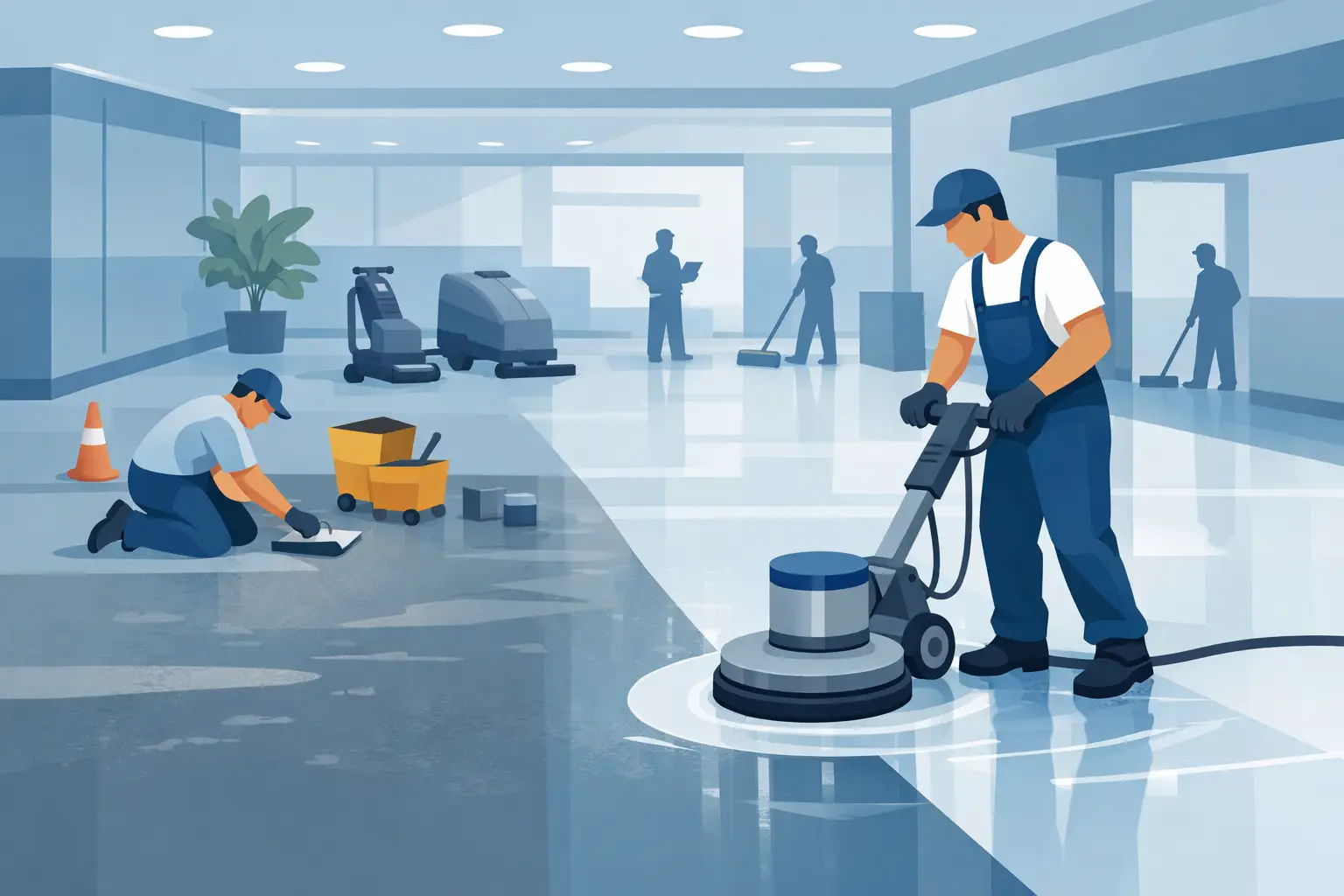
Commercial Floor Resurfacing Guide for Facilities
A worn commercial floor costs more than it first appears. Dust from failing concrete, peeling coatings, trip hazards, difficult cleaning, and a poor first impression all create operational problems. This commercial floor resurfacing guide helps facility managers, owners, and contractors choose a finish that fits the space, the traffic, and the schedule – not just the lowest initial price.
Resurfacing is not one product or one process. A retail showroom, restaurant kitchen, warehouse aisle, office lobby, and airplane hangar place very different demands on a floor. The right system starts with an honest assessment of the existing slab and ends with a finish built for how the facility actually operates.
When Commercial Floor Resurfacing Makes Sense
Commercial resurfacing is often the practical answer when the concrete slab is structurally sound but its surface has deteriorated. Common signs include spalling, surface pitting, minor cracking, old coating failure, uneven texture, tire wear, stains, and persistent dusting. In many cases, removing the weak surface layer, repairing defects, and installing a compatible finish costs less and causes less disruption than demolition and replacement.
Resurfacing is not the right answer for every slab. Active movement, major settlement, widespread moisture problems, or structural cracking may require additional repair or engineering before a new surface is installed. Covering those issues with a coating can make the floor look better temporarily, but it will not stop the underlying failure.
A qualified contractor should inspect the substrate in person, identify the cause of the damage, and explain what preparation is necessary. That site visit matters because concrete that looks similar from above can behave very differently once grinding begins.
Start With the Environment, Not the Color
The most dependable flooring decisions begin with use conditions. Before selecting a system, define the traffic, exposure, cleaning routine, downtime window, and appearance requirements for the space.
A warehouse or manufacturing floor may need high abrasion resistance, impact resistance, and clear striping for safety and workflow. A restaurant may need a textured finish that improves traction in wet areas and stands up to grease, cleaning chemicals, and frequent mopping. Retail and office environments may prioritize a clean, polished appearance with easy maintenance. Parking structures need systems that address vehicle traffic, hot tires, water exposure, and concrete protection.
Chemical exposure also changes the recommendation. Battery acid, oils, solvents, food acids, fuels, and aggressive cleaners can damage the wrong coating system. A decorative epoxy may be a strong fit for an office or showroom but may not be the best standalone choice for a heavy industrial environment. The coating, thickness, texture, and topcoat should be specified around real exposure conditions.
Choosing the Right Resurfacing System
Several commercial floor systems can improve a damaged or outdated concrete surface. The right choice depends on slab condition, performance requirements, budget, and available closure time.
Concrete Grinding and Polishing
Grinding removes weak concrete, old adhesives, coatings, and surface contamination while creating a flatter, cleaner profile. When the existing slab has good integrity and the goal is a durable, low-maintenance architectural finish, polished concrete can be an excellent solution.
Polished concrete works especially well in retail spaces, offices, showrooms, schools, and some warehouses. It does not peel like a film-forming coating, and it can reduce dusting while giving the floor a professional appearance. However, deep repairs, heavy contamination, and extensive slab damage can remain visible. Polishing is a refinement process, not a way to hide major concrete problems.
Epoxy and Resinous Coatings
Epoxy systems create a protective layer over prepared concrete. They can be built for color, chemical resistance, decorative flakes, safety markings, and easier cleaning. Depending on the system, a urethane or polyaspartic topcoat may be used to improve UV stability, scratch resistance, or cure time.
These systems are popular for warehouses, commercial kitchens, garages, service areas, laboratories, and industrial workspaces. Their performance depends heavily on preparation. Applying epoxy over dusty, damp, contaminated, or poorly profiled concrete is one of the fastest ways to create adhesion failure.
Cementitious Overlays and Repair Mortars
When the floor has widespread surface damage, a cementitious overlay can provide a new wear layer before receiving a coating, stain, or other finish. Repair mortars can rebuild spalls, patch divots, address deteriorated edges, and restore areas damaged by forklift traffic or old anchors.
Overlays are useful, but they are not a shortcut around substrate evaluation. The existing concrete must be stable, properly prepared, and compatible with the overlay material. Thickness, bond strength, and curing requirements should match the intended use of the floor.
Surface Preparation Determines the Result
The visible finish gets attention, but surface preparation determines whether a resurfacing system lasts. Concrete needs to be mechanically prepared to remove weak material and create the proper profile for the selected coating or overlay. Diamond grinding, shot blasting, scarifying, crack repair, joint treatment, and moisture testing may all be part of the scope.
Cleaning alone is rarely enough. Oils can penetrate concrete, old coatings can leave behind weak layers, and invisible curing compounds can interfere with adhesion. A contractor should test and inspect the floor rather than assume it is ready based on appearance.
Moisture deserves particular attention. Concrete releases moisture vapor, and high moisture levels can contribute to blistering, delamination, or coating failure. Some projects need a moisture-mitigation primer or a system designed for higher vapor transmission. The correct approach depends on test results and the coating manufacturer’s requirements.
Plan the Project Around Business Operations
Commercial flooring work does not have to shut down an entire facility, but it does require coordination. A good resurfacing plan separates the work into manageable phases, identifies access routes, protects adjacent areas, and schedules noisy or odor-producing work during the least disruptive hours.
For many facilities, nights, weekends, and staged sections are the practical choice. This is especially useful in retail stores, offices, medical facilities, restaurants, and active warehouses where operations cannot stop for days. The trade-off is that phased work can increase mobilization and coordination needs, but it may be worth it to keep revenue-producing areas open.
Ask early about cure times. Grinding and polishing may allow traffic sooner than a multi-coat resinous system, while fast-cure materials can shorten downtime but may cost more. Vehicle traffic, foot traffic, equipment loads, and washdown exposure each have different return-to-service timelines. Do not schedule move-in based only on when the floor feels dry.
Build Safety Into the Finish
A floor that looks clean but becomes slippery when wet is not a successful commercial installation. Traction should be discussed during system selection, particularly near entrances, food service areas, restrooms, loading zones, ramps, and washdown spaces.
Texture can be added through broadcast aggregates or specific coating finishes. More texture generally improves slip resistance, but it can also make cleaning more labor-intensive. The best balance depends on the area. A lobby may need a smoother, easier-cleaning finish, while a commercial kitchen or service bay may need a more aggressive profile.
Floor markings are another practical part of resurfacing. Safety lanes, equipment zones, pedestrian walkways, hazard boundaries, and parking designations can be incorporated into the system for a cleaner, more durable result than temporary tape or paint.
Budget for Lifecycle Value, Not Just Installation
The least expensive proposal is not always the lowest-cost floor over time. A thin coating with limited preparation may look attractive at first, but repeated patching, peeling repairs, and early replacement can create higher costs and more downtime later.
Compare proposals by scope, not just square-foot pricing. Look at surface preparation methods, repair allowances, moisture testing, material type, coating thickness, topcoat specifications, traction requirements, and expected maintenance. If one quote skips preparation or excludes visible damage, it is not directly comparable to a full resurfacing system.
Maintenance should also match the finish. Polished concrete benefits from routine dust removal and appropriate cleaning products. Resinous floors need regular cleaning, prompt attention to chemical spills, and avoidance of harsh tools that can scratch or wear the topcoat. A contractor should provide clear care guidance after the project is complete.
Get a Site-Specific Resurfacing Plan
The best commercial floor resurfacing guide ends with a simple rule: specify the floor for the work it must perform. A durable floor starts with the slab, the traffic pattern, the exposure risks, and the time available to complete the work. Orange County Concrete Polishing provides in-person evaluations and tailored proposals so commercial clients can address those details before work begins.
If your floor is dusting, cracking, peeling, staining, or becoming difficult to maintain, schedule an on-site assessment before the damage spreads. A properly scoped resurfacing project can restore the appearance, safety, and working life of the floor while keeping disruption under control.
Recent Post
Overnight Floor Installation Planning That Works September 20, 2026 1:51 am
Top Commercial Floor Coating Options for Business September 18, 2026 1:53 am
What Causes Epoxy Floor Bubbles? 7 Common Reasons September 16, 2026 1:53 am