
How to Fix Uneven Concrete Without Replacing It
A trip hazard at a front walk, a forklift bump in a warehouse aisle, or a garage floor that pitches water toward the wall is more than an eyesore. Knowing how to fix uneven concrete starts with identifying why the slab moved or wore unevenly. The right repair can restore safe access, proper drainage, and a clean finished appearance. The wrong one can hide the issue briefly, then crack, peel, or fail under traffic.
For Orange County homes and commercial facilities, the best approach depends on the amount of elevation change, the condition of the concrete, and how the area will be used. A decorative garage floor has different requirements than a loading area, retail entry, parking structure, or airplane hangar.
Start by Finding the Cause of the Unevenness
Concrete rarely becomes uneven without a reason. Before selecting a repair method, inspect the slab and the surrounding conditions. If the cause is still active, a new coating or patch will not solve the long-term problem.
Settlement is one of the most common causes. Soil may compact, wash out, or shift beneath a slab, leaving one section lower than the next. This is common around walkways, patios, driveways, and exterior building edges where drainage sends water beneath the concrete.
Heaving creates the opposite problem. Tree roots, expansive soils, and moisture-related movement can push part of a slab upward. In older concrete, curling at joints, worn high spots, and failed patch areas can also create abrupt changes in elevation.
Indoors, unevenness may be part of the original placement. A warehouse or commercial floor can have low areas that collect water, equipment vibration, or years of wear near doors and travel lanes. Garage slabs frequently slope by design toward the overhead door, but excessive slope, birdbaths, or reverse drainage need correction before installing a finish system.
A professional assessment should look beyond the visible edge. We check for cracks, hollow-sounding areas, moisture concerns, active movement, drainage paths, and the intended use of the floor. That information determines whether the slab is a candidate for grinding, leveling, resurfacing, lifting, or replacement.
How to Fix Uneven Concrete: Match the Repair to the Problem
There is no single product that fixes every uneven slab. The repair needs to address both the vertical difference and the service conditions the concrete will face afterward.
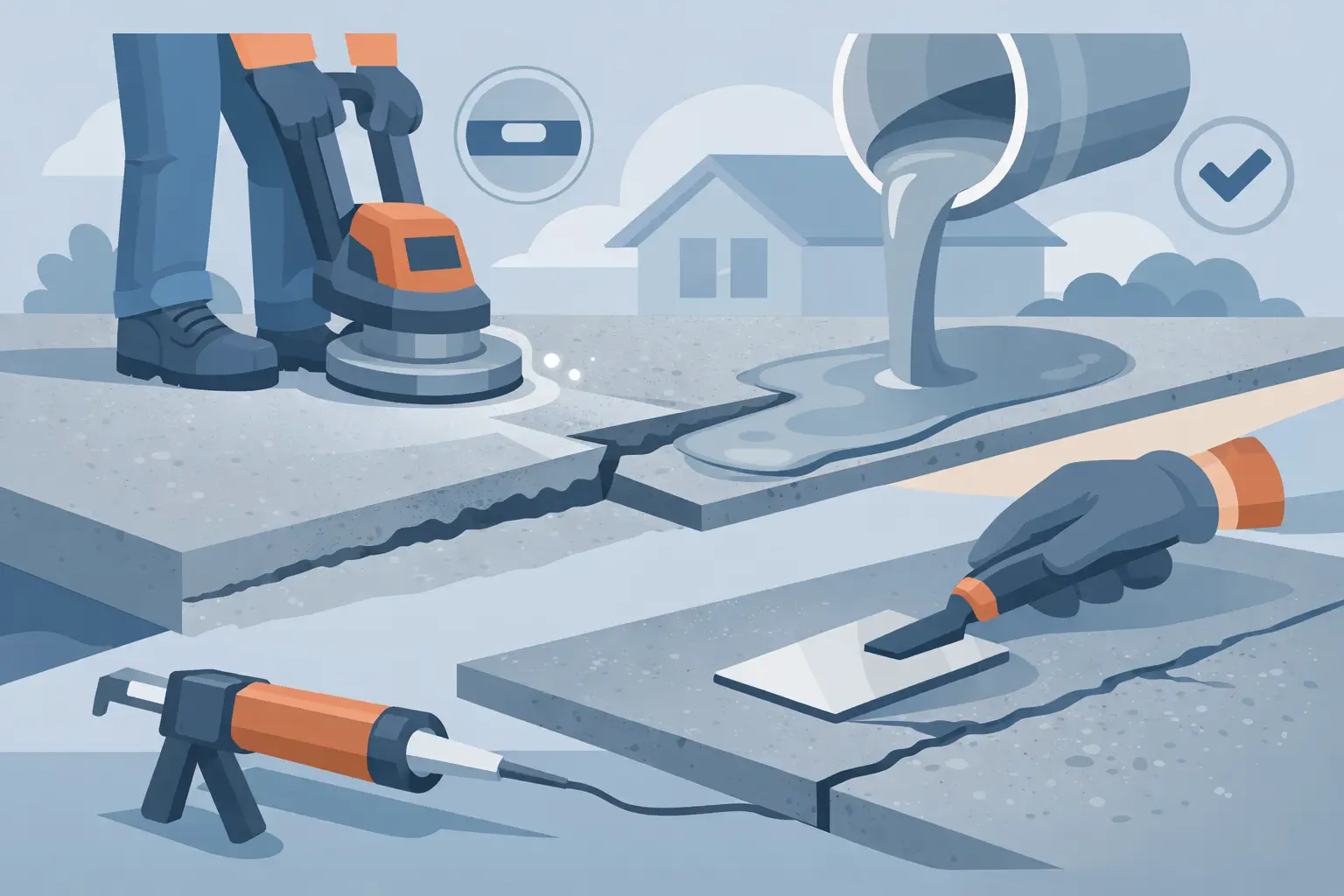
Grind down raised edges and high spots
Diamond grinding is often the most practical solution when one slab edge sits slightly higher than the adjacent section. It removes concrete from the elevated area to create a smoother transition. This is a common approach for trip hazards at sidewalks, patios, entrances, and interior floor transitions.
Grinding works best when the elevation difference is relatively minor and the slab is otherwise stable. It is precise, fast compared with demolition, and creates an ideal profile for polished concrete, stains, dyes, epoxy, or other floor finishes when those are part of the project.
The trade-off is simple: grinding removes material. It cannot correct a deeply settled slab without taking away too much concrete from the high side. It also will not stop future settlement. If the lower slab continues to sink, the height difference may return.
Fill low areas with a cementitious leveling system
For shallow depressions, uneven interior floors, or surfaces that need a flatter finish before coating, a professional-grade cementitious underlayment or self-leveling system can be highly effective. The material flows or is placed across prepared concrete to fill low points and create a more uniform plane.
Surface preparation is what makes this method work. The slab must be mechanically profiled, cleaned of contaminants, and evaluated for moisture. Paint, adhesive, oil, curing compounds, and weak concrete can prevent a leveling material from bonding correctly. Cracks and joints also need to be handled in a way that accounts for movement.
Leveling systems are a strong fit for offices, retail spaces, residential interiors, and garages that will receive an epoxy, polyaspartic, polished, or decorative concrete finish. They can correct broad low areas without tearing out sound concrete. However, they are not automatically the right answer for exterior slabs or areas with ongoing ground movement. Water exposure, freeze-thaw conditions, traffic loads, and drainage requirements all affect product selection.
Resurface worn or broadly uneven concrete
Concrete resurfacing is designed for slabs with widespread cosmetic wear, shallow scaling, minor pitting, and surface irregularities. A properly installed resurfacing system can renew the appearance of aging concrete while improving the surface for foot traffic, vehicles, or a decorative finish.
Resurfacing is not a shortcut for structural failure. If the slab has major settlement, severe cracking, unstable sections, or poor drainage beneath it, a thin overlay may crack with the original concrete. The concrete must be sound enough to support the new system.
For a garage, patio, commercial entry, or work area, resurfacing may be paired with a protective coating that improves stain resistance and cleaning. In industrial settings, the selected system should also account for abrasion, rolling loads, chemicals, and thermal exposure. A finish that looks good in a home garage may not hold up in a warehouse traffic lane.
Lift settled slabs when the concrete is still in good condition
When an entire slab has settled but remains structurally intact, slab lifting can bring it back toward its original elevation. Depending on the situation, this may involve polyurethane foam injection or a grout-based lifting process beneath the concrete.
Lifting is particularly useful for exterior walkways, driveways, patios, and certain commercial slabs where replacement would be disruptive. It avoids the cost and waste of demolition while correcting a substantial height difference that grinding cannot reasonably address.
The limitation is that lifting does not repair every cracked or deteriorated slab. The soil condition must be evaluated, and drainage should be corrected so water does not continue washing out support beneath the concrete. After lifting, joints, cracks, and surface transitions may still require repair or finishing work.
Replace concrete when movement or damage is too severe
Replacement is sometimes the most reliable answer. If concrete is badly broken, has extensive subgrade failure, is crumbling from deterioration, or cannot be brought into proper drainage and elevation with repair methods, a new slab may be the better investment.
This is especially true where safety, drainage, or equipment operation is critical. A facility manager may lose more money to repeated patching, equipment wear, and operational interruptions than to a properly scoped replacement. The key is not replacing concrete by default. It is choosing replacement when repair would only postpone a predictable failure.
Preparation Determines Whether the Repair Lasts
A flat-looking floor is not necessarily a durable floor. Successful concrete leveling and resurfacing depend on surface preparation, material compatibility, and the final flooring system.
Mechanical grinding is commonly used to remove weak surface material and open the concrete for bonding. Cracks may require routing, filling, stitching, or flexible joint treatment depending on whether they are static or active. Moisture testing is also critical before many coatings and leveling products are installed. Excess vapor transmission can cause blistering, discoloration, or bond failure if ignored.
Drainage deserves the same attention. On exterior concrete, water should move away from structures and not pond along travel paths. In garages and commercial spaces, the repaired floor must work with door thresholds, drains, ramps, equipment clearances, and adjacent flooring. Correcting a low spot without checking the final slope can simply move the water problem somewhere else.
Choose the Finish Around Real-World Use
Once the slab is even, the finish should match the environment. Polished concrete is a durable, low-maintenance choice for many interiors, offices, retail spaces, and warehouses. It offers a clean appearance without adding a separate film coating, though the concrete needs to be in suitable condition for the desired polish level.
Epoxy and polyaspartic systems are popular in garages, showrooms, work areas, and commercial spaces because they can provide color, decorative flakes, chemical resistance, and easier cleanup. Proper preparation and moisture control remain essential. For wet areas, traction additives can improve slip resistance, although more texture can make routine cleaning slightly more involved.
Industrial and commercial floors often need a more specific specification. Forklift traffic, point loads, oil, cleaning chemicals, hot tires, and operating schedules all influence the repair and finish system. Completing work during off-hours can reduce disruption, but the floor also needs enough cure time before it returns to service.
When to Call a Concrete Flooring Professional
Small cosmetic imperfections may be manageable with a basic patch, but avoid treating a significant elevation change as a weekend repair. Call a professional when cracks are widening, slabs are moving, water is entering the building, a trip hazard is present, or the floor will receive a coating or polished finish. These conditions require the right equipment, preparation standards, and material selection.
Orange County Concrete Polishing provides in-person evaluations and tailored proposals for concrete grinding, leveling, resurfacing, polishing, and protective floor systems. A site visit makes it possible to assess the slab, confirm the cause of the issue, and recommend a repair that fits the traffic and finish requirements instead of applying a one-size-fits-all patch.
An uneven slab does not always need to be torn out, but it does need an honest diagnosis. Address the movement, prepare the concrete correctly, and choose a repair built for the way the space actually operates. That is how a safer, flatter floor stays that way.
Recent Post
Best Industrial Floor Systems for Demanding Sites
October 16, 2026 1:51 am
How to Prevent Concrete Delamination Early
October 14, 2026 1:51 am

Warehouse Floor Safety Guide for Busy Facilities
October 12, 2026 1:45 am