
Grinding vs Resurfacing Concrete: Which Is Right?
A garage floor with peeling coating, a warehouse slab with uneven traffic lanes, or a retail entry worn smooth by foot traffic may all look like candidates for the same repair. They are not. Grinding vs resurfacing concrete comes down to one practical question: can the existing slab be improved by removing material, or does it need new material installed over the top?
The right answer affects appearance, downtime, maintenance, and the lifespan of the finished floor. Grinding can expose a sound, clean concrete surface for polishing, coating, or a safer walking profile. Resurfacing can renew a worn slab with a new cement-based layer when the surface damage is too widespread to grind away efficiently. A professional site evaluation is the best way to avoid spending money on a finish that will not hold up.
What Concrete Grinding Actually Does
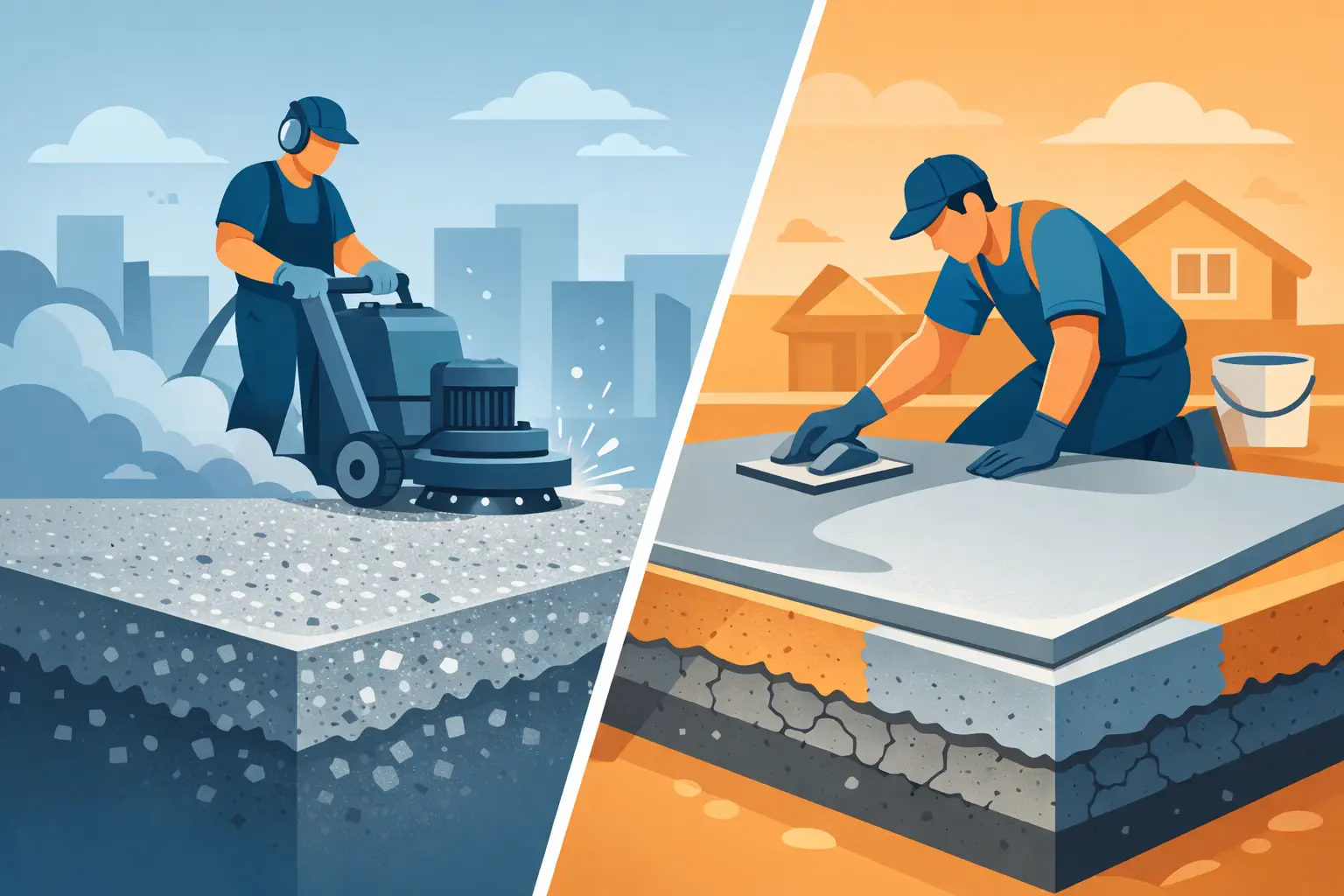
Concrete grinding uses diamond-equipped machines to mechanically remove a controlled amount of the existing slab. It is not a cover-up. The process cuts through old adhesives, failing coatings, paint, minor surface irregularities, and weak concrete at the top of the slab.
For a sound floor, grinding is often the most direct path to a durable finish. In a garage, it can remove a deteriorating prior coating and create the proper surface profile for a new epoxy system. In an office, showroom, or residence, progressive grinding and polishing can turn the concrete itself into a clean, modern finished floor. In industrial facilities, grinding may be used to eliminate trip edges, prepare repair areas, or improve the slab before a high-build coating is installed.
Grinding works best when the problem is near the surface. Minor high spots, light scaling, tire marks, coating failure, and contaminants can frequently be addressed without adding a new layer. The finished result depends on the condition and makeup of the original concrete. A slab with heavy patching, deep spalling, or significant cracking may still need repairs or another system after grinding.
When grinding is the better choice
Choose grinding when the concrete is fundamentally stable and the goal is to prepare, level, or reveal the existing floor. It is especially effective for floors that need a polished concrete finish, epoxy or urethane coating, stain, dye, or a clean profile for another bonded system.
Grinding also preserves more headroom than resurfacing. That matters near door thresholds, loading docks, drains, equipment clearances, and transitions to adjacent flooring. Because it removes material instead of building up the floor, it can be the smarter option where elevations are already tight.
There is a limit. Grinding cannot correct a slab that has settled significantly, has active structural movement, or has deep deterioration throughout the surface. Taking too much material from an already weak slab can expose more problems rather than solve them.
What Concrete Resurfacing Does
Concrete resurfacing installs a new cementitious material over properly prepared existing concrete. Depending on the application, the system may be a thin overlay, a self-leveling underlayment, a repair mortar, or a more substantial resurfacing product designed for traffic and wear.
Resurfacing is used when the surface is too damaged, rough, pitted, or uneven for grinding alone to produce the desired result. It can cover widespread cosmetic defects and create a more consistent plane for a final coating, decorative treatment, or serviceable commercial floor.
A successful resurfacing project starts with preparation, not the overlay itself. The existing concrete must be evaluated for weak areas, contamination, moisture concerns, cracks, bond issues, and movement. Loose material needs to be removed, the surface needs a proper mechanical profile, and repairs must be completed with compatible materials. If preparation is skipped, even a premium resurfacer can debond under traffic.
When resurfacing is the better choice
Resurfacing is generally the better fit when a floor has extensive surface spalling, widespread shallow pits, rough previous repairs, or low areas that need to be brought up. A parking structure walkway, aging patio, commercial entry, or warehouse work area may benefit from a new wear layer when visual consistency and function matter more than exposing the original slab.
It is also useful when floor flatness is a concern. A self-leveling or repair system can address depressions that grinding would require excessive removal to correct. For facilities that use carts, pallet jacks, shelving, or rolling equipment, a flatter surface can reduce vibration, improve mobility, and limit recurring damage at uneven transitions.
Resurfacing adds thickness, so thresholds, drain elevations, ramps, and door swing clearances must be reviewed before work starts. The added layer also needs to match the environment. A decorative residential overlay is not automatically suitable for forklift traffic, hot tires, chemical exposure, or constant moisture.
Grinding vs Resurfacing Concrete for Common Projects
For most Orange County garages, grinding is the starting point. It removes failed coatings and opens the concrete so an epoxy, polyaspartic, or urethane system can bond correctly. If the slab has minor cracking or isolated spalls, those areas can often be repaired during preparation. If it has broad surface failure, a resurfacing system may be needed before coating.
For polished concrete, grinding is essential. The process determines aggregate exposure, sheen level, and overall uniformity. Resurfacing is not a substitute for polishing an existing slab, although certain overlays can be polished when the selected material and project conditions support that finish.
For warehouses and industrial spaces, the decision usually centers on traffic and slab condition. Grinding is effective for coating removal, trip-hazard reduction, joint repair preparation, and leveling limited high spots. Resurfacing may be more practical when a large portion of the slab is worn or when consistent floor elevation is needed across an operating area.
Retail and office properties often need both visual improvement and a manageable schedule. Grinding can be lower-profile and efficient for floors with sound concrete beneath outdated finishes. Resurfacing gives greater visual control where old patchwork, damage, or surface variation would remain visible after grinding. In either case, off-hours scheduling can reduce disruption to customers and staff.
Cost, Downtime, and Maintenance Considerations
Neither option is automatically cheaper. Grinding can be more cost-effective when only the top layer needs attention, but the price rises with heavy coating removal, difficult access, dense concrete, extensive repairs, or a high-polish specification. Resurfacing can provide a more uniform appearance over damaged concrete, but it adds material, labor, curing time, and detailed preparation requirements.
Downtime depends on the system selected after the surface work. A ground-and-polished floor may be ready for use quickly as work progresses, while some resurfacing materials require curing before they can accept traffic or a coating. Fast-cure systems are available for projects with tight operating windows, but product selection should be based on the required performance, not just the fastest return to service.
Maintenance also changes with the final finish. Polished concrete is low-maintenance but still needs routine dust removal and appropriate cleaning products. Coated floors need regular cleaning and may require future touch-ups in high-wear areas. Resurfaced floors perform best when the overlay is protected with a finish suited to water, chemicals, abrasion, and the expected traffic load.
Problems Neither Method Can Ignore
Grinding and resurfacing treat the surface. They do not stop an active structural crack, correct ongoing slab settlement, or solve water pressure coming up through concrete without addressing the source. A crack that is moving can transfer through a new overlay or coating. Moisture vapor can also compromise bonded flooring systems if it is not tested and managed correctly.
Before recommending a solution, a qualified contractor should inspect the concrete for delamination, moisture conditions, joint movement, drainage issues, and the type of traffic the floor will receive. A hangar floor, restaurant kitchen, residential garage, and retail boutique each require different surface preparation and finishing decisions.
Make the Repair Match the Floor
The best floor repair is not the one that looks good on day one. It is the one that fits the slab condition, the use of the space, and the performance expected years from now. Grinding is often the right answer for sound concrete that needs preparation, correction, or a polished finish. Resurfacing is often the better investment when damaged concrete needs a new, bonded wearing surface.
Orange County Concrete Polishing can evaluate the slab in person, explain the practical options, and provide a tailored proposal for your garage, commercial property, or industrial facility. Get a quote before choosing a system, especially when cracks, moisture, heavy traffic, or existing coating failure are part of the job.
Recent Post
Best Industrial Floor Systems for Demanding Sites
October 16, 2026 1:51 am
How to Prevent Concrete Delamination Early
October 14, 2026 1:51 am

Warehouse Floor Safety Guide for Busy Facilities
October 12, 2026 1:45 am