
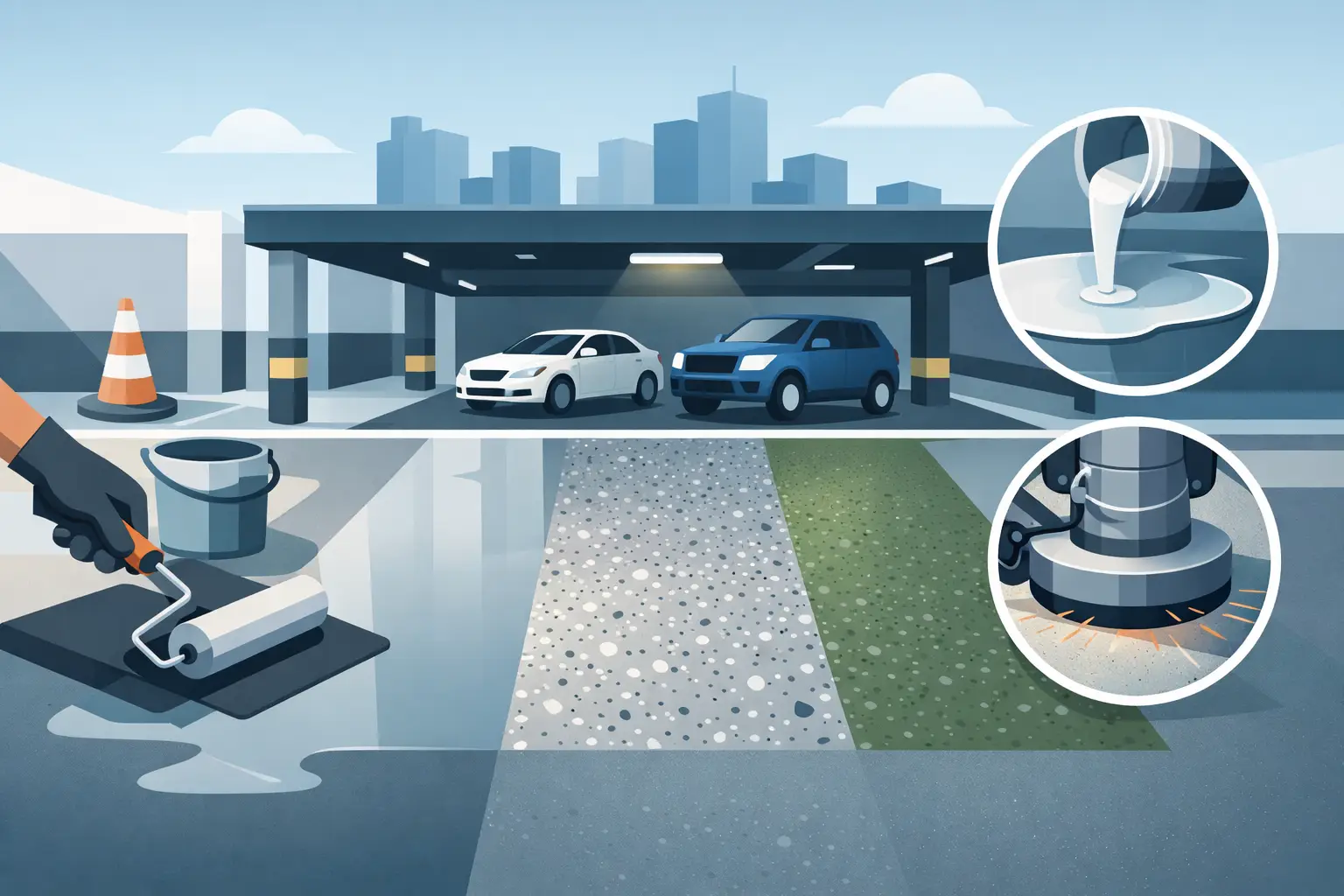
Parking Garage Concrete Coating Options
A parking structure does not fail all at once. It starts with tire wear at the turns, staining at the stalls, moisture creeping into weak spots, and surface dust that never seems to stop. A well-selected parking garage concrete coating helps stop that cycle early by protecting the slab, improving traction, and making the structure easier to maintain under constant vehicle traffic.
For property owners, facility managers, and general contractors, that matters for more than appearance. Parking garages take a daily beating from hot tires, oil drips, brake fluid, water intrusion, UV exposure on top decks, and the repeated stress of cars turning, stopping, and idling. Bare concrete rarely holds up as long as people expect. The right coating system can extend service life, reduce maintenance, and give the entire structure a cleaner, more professional finish.
What a parking garage concrete coating is actually designed to do
A garage coating is not just paint rolled over a slab. In a true commercial parking environment, the system has to perform under pressure. That usually means resisting abrasion, handling chemical exposure, tolerating thermal movement, and creating a surface profile that supports both adhesion and slip resistance.
In practical terms, the coating acts as a protective barrier between traffic and the concrete below. It helps limit moisture penetration, slows surface wear, and makes routine cleanup more manageable. In many facilities, that alone can reduce the pace of visible deterioration.
The exact system depends on where it will be installed. A ground-level parking area has different demands than a multi-level garage or exposed top deck. Entry and exit lanes see concentrated tire friction. Ramps need stronger traction. Pedestrian walkways may call for a different texture and appearance than vehicle lanes. Good results come from matching the coating to the use, not forcing one product across the entire structure.
Why bare concrete breaks down so quickly in parking structures
Concrete is durable, but it is still porous. Once moisture, salts, chemicals, and oils start working their way into the slab, the damage usually becomes more expensive to correct. Surface cracking, spalling, staining, and delamination are often signs that the floor was left unprotected too long or coated without the right prep.
Traffic patterns also matter. The areas under steady wheel movement wear differently than parking stalls. Tight turning zones create shear stress that can tear up weak coatings fast. If the slab has previous repairs, old sealers, or contamination embedded in the surface, coating failure becomes even more likely unless the floor is properly ground and prepared first.
That is why surface prep is not the side note in these projects. It is the project. Even a high-quality material will fail if it is applied over weak concrete, trapped moisture, grease, or loose residue.
Choosing the right parking garage concrete coating system
There is no universal best coating for every garage. The best choice depends on traffic volume, exposure conditions, downtime requirements, and budget.
Epoxy systems
Epoxy is a strong option for many interior parking areas because it provides excellent adhesion, solid chemical resistance, and an attractive finished appearance. It can be built with texture for slip resistance and customized for striping, safety markings, and zone differentiation.
That said, epoxy is not always the best fit for every exposed surface. UV exposure can affect some epoxy systems over time, and areas with movement or weather exposure may need a more flexible top layer or a different chemistry altogether.
Urethane and polyaspartic topcoats
Where added UV stability, abrasion resistance, or faster return-to-service is needed, urethane or polyaspartic coatings often make sense. These systems are frequently used as topcoats over properly prepared base layers. They can improve wear performance and color retention while helping the floor hold up better under heavy use.
The trade-off is cost and application sensitivity. Faster-curing products can reduce downtime, which is a major advantage for active properties, but they also require experienced installation and tighter jobsite control.
Traffic-bearing systems
For elevated decks, ramps, and exposed parking levels, a more specialized traffic-bearing membrane system may be the right move. These systems are built to handle moisture protection, crack-bridging performance, and sustained vehicle traffic in conditions that would overwhelm a basic coating.
They cost more upfront, but on the right structure they are often the more economical long-term decision because they protect the deck itself, not just the surface appearance.
Where performance matters most
Not every section of a garage should be treated the same way. One of the biggest mistakes in coating projects is assuming equal wear across the structure.
Ramps and turning areas
These are the highest-stress zones in most garages. Tires grip, twist, and heat up in these areas, which creates more aggressive wear than you see in standard parking stalls. Coating systems here need stronger traction and better resistance to shear forces.
Top decks and exposed levels
Sun, rain, standing water, and temperature swings create a very different challenge than enclosed parking. Coatings on exposed levels need to protect against weather-related damage and maintain performance even as the slab expands and contracts.
Parking stalls and low-speed areas
These spaces still need chemical resistance and easy cleaning, but they usually do not require the same aggressive build as ramps or drive lanes. That can help balance the budget without sacrificing overall performance.
Proper prep decides whether the coating lasts
A parking garage concrete coating is only as good as the substrate beneath it. Before any coating goes down, the concrete needs to be inspected for cracking, spalling, moisture issues, oil contamination, and previous coating failure. From there, the floor may need grinding, patching, crack repair, shot blasting, leveling, or localized resurfacing.
This is where experienced contractors separate themselves from basic painters. Surface profile has to match the coating system. Repairs have to be compatible. Moisture conditions have to be checked. Expansion joints and moving cracks have to be treated correctly. Skipping these steps might save a few dollars at the bid stage, but it usually costs much more later in callbacks, shutdowns, and premature replacement.
For active commercial properties, scheduling matters too. A contractor should be able to phase the project, work during off-hours when needed, and keep disruption to tenants, staff, and visitors under control. That is especially important in garages that support retail, office, hospitality, or mixed-use traffic.
What property owners gain from coating a parking structure
The most obvious benefit is protection, but the value goes further. A coated garage is easier to clean, easier to mark, and easier to keep looking maintained. That changes how the property is perceived.
For commercial buildings, the garage is often the first and last surface people experience. Stained, dusty, deteriorating concrete sends the wrong signal. A clean, properly coated structure supports a better tenant and visitor impression while helping maintenance teams manage the space more efficiently.
There is also a safety component. Slip-resistant textures, clearer striping, and defined pedestrian zones can improve usability. That does not mean every rougher texture is better – overly aggressive surfaces can become harder to clean or less comfortable in certain areas – but a balanced system can improve both traction and serviceability.
When it makes sense to recoat instead of replace
Not every worn garage needs full concrete replacement. If the slab is structurally sound and the damage is primarily surface-level, coating restoration can be a smart way to extend life without taking on the cost of major demolition.
The key is honest evaluation. If there is severe substrate failure, widespread delamination, or unresolved moisture intrusion, coating alone is not going to fix the problem. But when the underlying concrete is repairable, a properly specified system can restore appearance and function at a much lower cost than replacement.
That is where a site-specific proposal matters. Orange County Concrete Polishing approaches these projects by looking at real traffic conditions, damage patterns, and scheduling needs instead of forcing a one-size-fits-all answer.
What to look for in a coating contractor
Parking structures are demanding environments. The contractor should understand surface prep, repair methods, coating compatibility, slip resistance, and phased scheduling. They should also be clear about what the system can and cannot do.
If a proposal talks only about product brand and color, it is incomplete. The real conversation should include substrate condition, prep requirements, expected wear zones, cure times, and maintenance expectations. A good contractor will explain the trade-offs, not hide them.
The right parking garage concrete coating does more than improve appearance. It protects the slab, supports safer traffic flow, and helps the property operate with fewer headaches. If your garage is showing wear, now is the time to get it evaluated before small surface issues turn into larger repair costs. A detailed on-site quote will tell you what the concrete needs and what it will take to make it last.
Recent Post
Best Industrial Floor Systems for Demanding Sites
October 16, 2026 1:51 am
How to Prevent Concrete Delamination Early
October 14, 2026 1:51 am

Warehouse Floor Safety Guide for Busy Facilities
October 12, 2026 1:45 am